
VentProof reporting resources
Before-and-after dryer-vent documentation
A photo is more useful when the reader knows where it was taken and what it shows. An airflow reading needs the same context. Keep both attached to the visit they describe.
Make the photo pair understandable
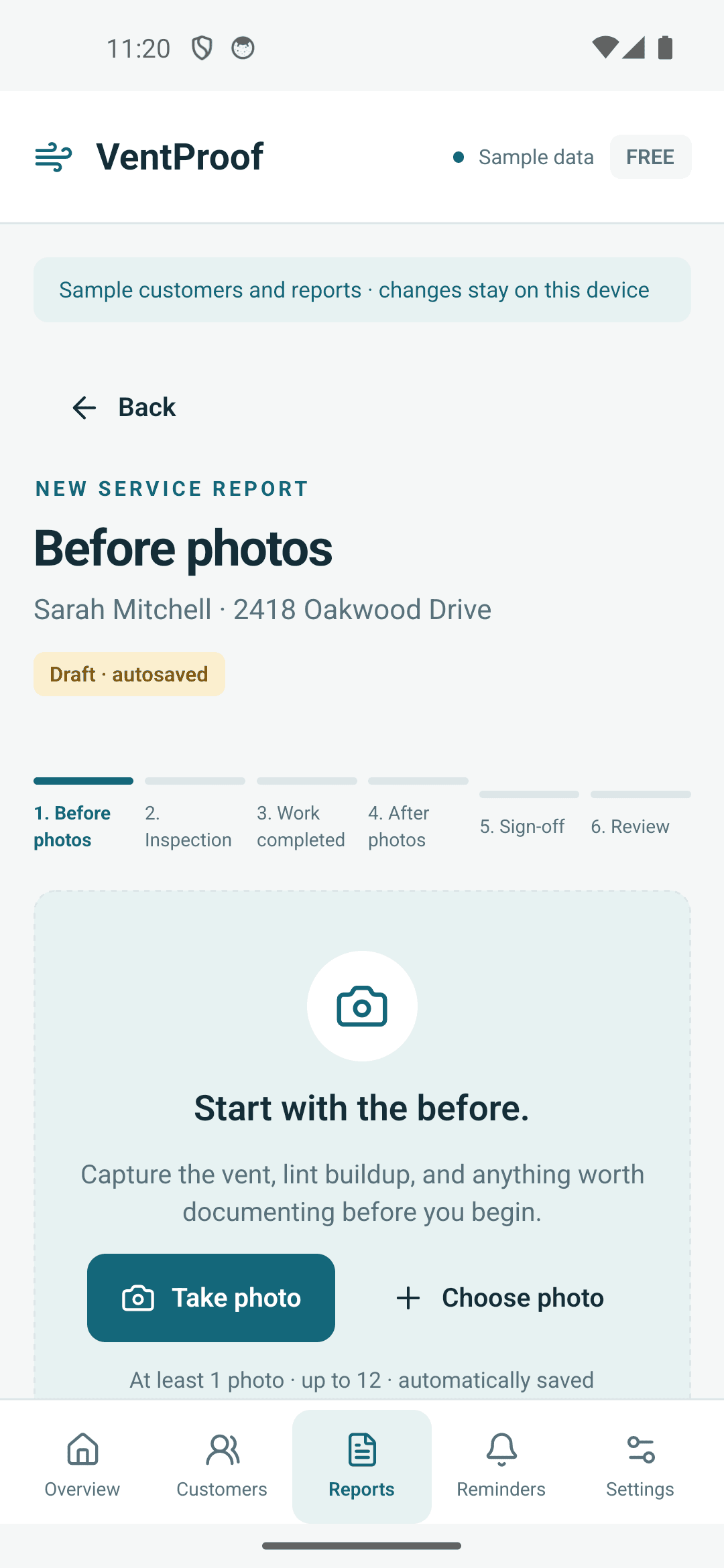
Take the before image before changing the condition. After work, return to the same component and a similar viewpoint. A wider context shot can identify the location; a closer shot can show the observation. Label each image before or after and give it a short, factual caption.
For example: “Before — exterior wall termination; visible lint at the damper” and “After — same termination following removal of visible lint.” Those captions describe what is visible without claiming that a photograph proves the entire system is clear.
VentProof attaches photos to the service record, supports captions, and lets technicians annotate images. An arrow or circle can draw attention to an observation; the original observation still needs a plain-language explanation.
Record measurements with their conditions
Use the airflow documentation guide to record the measurement point, method, instrument, and dryer settings consistently.
VentProof provides fields for before and after airflow, unit, and measurement location. Use technician notes for the instrument, dryer setting, and any changed conditions. If the location or test setup changes, explain that before drawing a comparison.
| Field | What the reader needs |
|---|---|
| Values | The actual readings, without filling a missing value with an estimate. |
| Unit | CFM, ft/min, or m/s as measured. CFM is volume flow; ft/min and m/s are velocity. |
| Location | The measurement point, such as the exterior termination. |
| Conditions | The equipment and operating conditions used for each reading. |
| Limits | Any access limit, setup change, or uncertainty that affects interpretation. |
A larger after value under comparable conditions records a change in the measurement. It does not, by itself, prove code compliance, eliminate fire risk, or establish that every hidden section was inspected. This guide does not prescribe a universal pass/fail threshold.
Keep findings separate from conclusions
“Damper did not open during the observed test” is an observation. “Recheck the termination after repair” is a recommendation. “The entire system is safe” reaches beyond either statement. Use wording that reflects the area actually inspected and the work actually performed.
Mark uninspected components as not inspected. Document unresolved concerns and no-access visits explicitly. If a customer is absent, record the missing acknowledgement reason rather than creating a sign-off.
Protect the customer while making the record useful
Frame photos around the work. Avoid faces, private documents, access codes, and unrelated belongings. Share the visit record through the intended customer workflow. A report used publicly as a sample should contain fictional details, not a lightly edited customer record.
Use the service report checklist for the complete record and the fictional sample report to see the real report layout.